

















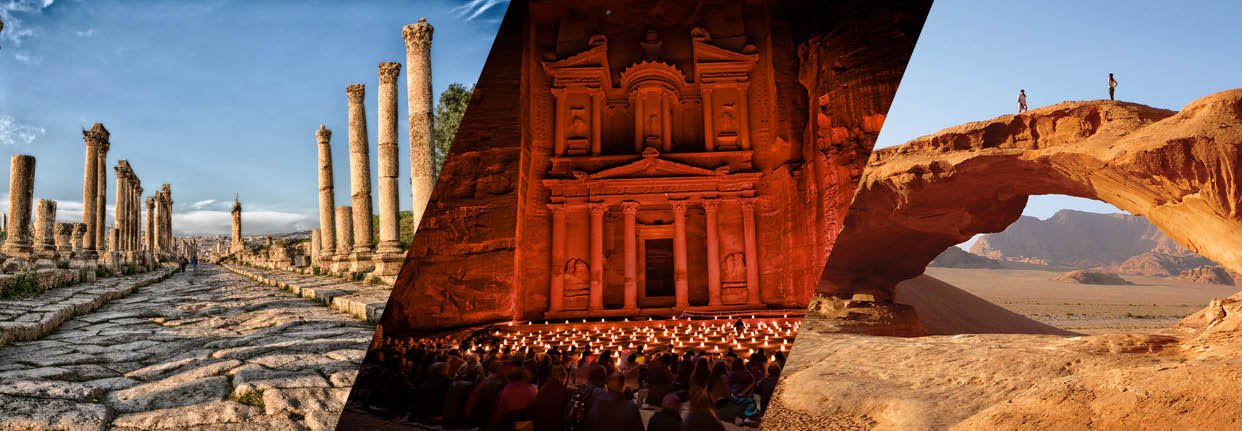
 From Roman legions marching through ancient cities, to the desert campaigns of 1916 unfolding across the dunes of Wadi Rum, to the intricate mosaic artistry of Madaba brought to life before their eyes, these experiences are a blend historical accuracy with theatrical staging, live performance, and site-specific storytelling, offering a far more participatory alternative to traditional guided tours.
Here are the four absolute must that you must experience yourself:
Walk through Roman history in Jerash
Jerash is the kind of place where history feels remarkably close. Visitors can walk along the ancient colonnaded streets, explore temples and public spaces, and enter the South Theatre that once hosted performances for the city’s residents. Rather than simply looking at Roman ruins, travellers can spend time exploring the city and imagining what everyday life may have looked like here almost two thousand years ago.
The city’s golden age came under Roman rule, and today Jerash is recognised as one of the best-preserved Roman provincial towns in the world. Its streets, theatres, temples, fountains and plazas reveal the scale and character of Roman urban life in the region.
The South Theatre, built between 90–92 AD, could accommodate more than 3,000 spectators and is known for its remarkable acoustics. The original Cardo, still paved with its ancient stones, also gives visitors a sense of how the city was planned and experienced centuries ago.
Take the journey through 1916 in Wadi Rum
Wadi Rum is famous for its vast desert landscapes, but there is another story waiting to be discovered here. The Journey Through 1916 experience takes visitors back to the period of the Great Arab Revolt through an immersive train experience.
Developed with the support of the Jordan Heritage Revival Company (JHRC), a key-partner in the Kingdom’s historic tourism sector, Jordan Tourism Board is promoting this history-based experience that channels tourism revenue directly into local communities, including employment opportunities for retired military personnel and residents of underserved areas.
The experience features a collection of working steam locomotives that were formerly used as part of a pilgrimage route and are closely associated with the Great Arab Revolt. This adds a historical dimension to a destination otherwise widely known for its dramatic desert landscapes.
Travelling through the desert while discovering the history associated with the revolt creates a very different way to experience Wadi Rum. It brings together the landscape, the story and the sense of adventure in one experience. The experience allows visitors to connect with an important chapter in Jordan’s modern history while experiencing the unique setting of Wadi Rum.
Discover the stories behind Madaba’s mosaics
In Madaba, history can be found in extraordinary detail. Known as the City of Mosaics, the destination is home to the famous 6th-century Madaba Mosaic Map, which depicts the Holy Land and surrounding areas.
Exploring the city’s historic churches and mosaic traditions gives visitors an opportunity to see how craftsmanship, faith and history have been passed down through generations. The mosaic map is housed in the Greek Orthodox Church of St. George and is a remarkable record of Byzantine Jordan, Palestine and lower Egypt. Made from hundreds of thousands of naturally coloured tesserae, the surviving map continues to offer a detailed glimpse into the geography of the region.
Beyond the famous map, Madaba is home to other Byzantine and Umayyad mosaic works depicting flowers, plants, birds, animals and scenes from everyday life. The city’s Archaeological Park and Museum also preserve several important examples of this long-standing artistic tradition.
Follow the silk route in Petra
Petra was much more than the iconic Treasury seen in photographs. The ancient Nabataean city was an important trading hub where caravans travelling between Arabia, Egypt and the Levant came together. Goods, ideas and cultures passed through the city, making it an important link in the historic trade networks that connected the region.
Walking through the Siq and exploring Petra’s monuments today offers a chance to imagine the merchants, travellers and caravans that once made their way through this remarkable city.
During the Hellenistic and Roman periods, Petra became a major caravan centre for the incense of Arabia, the silks of China and the spices of India, positioning it at a crossroads between Arabia, Egypt and Syria-Phoenicia.
The city’s prosperity was closely linked to these trade routes, while its ingenious water-management system supported settlement in an otherwise arid landscape. Today, walking through its passages and gorges offers travellers a way to experience the scale of a city shaped by trade, culture and the movement of people across the region.
So, build your itineraries around these cultural and historical offerings and learn for yourself how these experiences represent a distinctive way to differentiate the destination — one rooted not in what visitors see, but in what they get to live.
Follow BOTT on LinkedIn, Facebook, Twitter & Instagram
Subscribe BOTT Channels on WhatsApp & Telegram to receive real time updates